

Why local SEO matters: dominate your area in 2026
TL;DR:
- Local SEO is essential for nearby customers, with Google Business Profile optimization playing a key role.
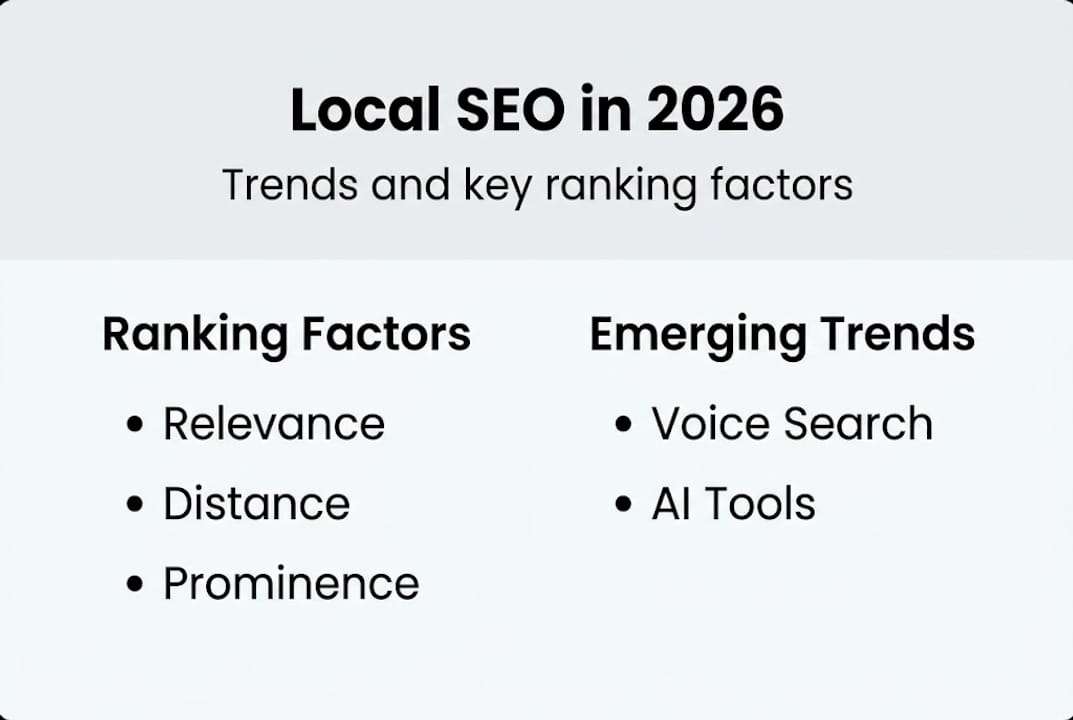
- Focus on relevance, distance, and prominence to improve local search rankings effectively.
- Trends for 2026 include AI voice search, mobile-first design, and structured data for better visibility.
Many local business owners assume SEO is something only big brands or online retailers need to worry about. That assumption is costing them customers every single day. When someone nearby searches for a plumber, a café, or a solicitor, Google serves up a shortlist of local businesses almost instantly. If you’re not on that list, you simply don’t exist to that potential customer. GBP optimisation accounts for roughly 32% of your local ranking weight, which means there are clear, practical steps you can take right now to improve your visibility. This guide explains what local SEO is, how it works, and what you can do to make it work harder for your business.
Table of Contents
Key Takeaways
| Point | Details |
|---|---|
| Local SEO boosts real customer actions | Effective local SEO means more calls, visits, and enquiries from people nearby. |
| Ranking factors are actionable | You can improve local rankings by focusing on relevance, distance, and prominence. |
| GBP matters most | Optimising your Google Business Profile has the greatest impact in local search. |
| Stay ahead with mobile and AI | Prioritising mobile and AI-friendly strategies keeps your business visible in 2026. |
What is local SEO and why does it matter?
Local SEO (search engine optimisation) is the practice of improving how your business appears in geographically relevant searches. Think of it as the digital equivalent of being listed prominently in the local directory, except far more powerful and far more targeted. Unlike general SEO, which aims to rank for broad terms nationally or globally, local SEO focuses on connecting you with people who are physically nearby and actively looking for what you offer.
For a bricks-and-mortar shop in Lewes, a tradesperson covering Surrey, or a service provider across Kent, this distinction matters enormously. Someone searching “emergency electrician near me” is not browsing casually. They need help now. Local SEO puts your business in front of those high-intent customers at exactly the right moment.
Over 60% of local searches now happen on mobile devices, which means people are searching while they’re out and about, ready to act. That’s a very different audience from someone idly scrolling on a laptop.
| Factor | Local SEO | Traditional advertising |
|---|---|---|
| Cost over time | Low ongoing cost | Recurring spend required |
| Targeting | Hyper-local, intent-driven | Broad, often wasteful |
| Longevity | Compounds over time | Stops when budget stops |
| Measurability | Calls, clicks, visits tracked | Difficult to measure |
The cost-efficiency of local SEO compared to paid advertising is one of its most compelling advantages. Once you build visibility, it keeps working without a constant spend.
Here’s what local search typically prompts people to do:
- Call the business directly
- Visit the premises in person
- Click through to the website
- Read or leave a review
- Request a quote or make a booking
“Local SEO drives cost-efficient, long-term visibility. Quick wins often appear within 30 days through Google Business Profile, with real momentum building over 60 to 90 days.”
For Google Business Profile optimisation, the rewards are tangible and measurable. This is where your local SEO journey should begin.
How Google decides who appears in local searches
With a grasp of why local SEO matters, it’s time to understand how Google actually decides which businesses to showcase locally. Google uses three core factors when ranking local results, and understanding each one helps you prioritise your efforts effectively.
Relevance is about how well your business matches what someone is searching for. Google looks at your business categories, the keywords on your website, and the content of your Google Business Profile (GBP). If your categories and descriptions don’t reflect what you actually do, you’ll miss relevant searches entirely.
Distance is straightforward. Google estimates how far your business is from the searcher’s location. You can’t change where you’re based, but you can ensure your address is accurate and consistent everywhere it appears online.

Prominence reflects how well known and trusted your business is. Reviews, inbound links, citations (mentions of your business name and address across the web), and overall online presence all feed into this. GBP optimisation carries roughly 32% weight in local rankings, making it the single most impactful action you can take.
| Ranking factor | Key actions |
|---|---|
| Relevance | Choose accurate GBP categories, use local keywords on your site |
| Distance | Keep your address consistent across all platforms |
| Prominence | Gather reviews, build citations, earn local backlinks |
Here are practical steps to strengthen each factor for your Sussex, Surrey, or Kent business:
- Select the most specific and accurate primary category in your GBP
- Add your full, correct address to your website, GBP, and all directories
- Ask satisfied customers to leave a Google review after every job
- Respond to every review, positive or negative, within 48 hours
- List your business on relevant local directories and keep details consistent
Understanding key SEO factors helps you focus effort where it counts rather than spreading yourself too thin. And if you want to go deeper on how Google ranks businesses, the mechanics are fascinating once you see how each signal connects.
Pro Tip: Responding to reviews doesn’t just show good manners. Google treats your responses as fresh, relevant content and rewards businesses that engage consistently with improved prominence scores.
Local SEO in 2026: Trends and evolving best practices
Having explored the fundamentals, let’s look at the latest trends and practical guidance for thriving with local SEO in 2026. The landscape has shifted noticeably, and businesses that adapt now will pull ahead of competitors who are still working from a 2022 playbook.
The biggest shift is the rise of AI-driven and voice search. People no longer type “plumber Lewes”. They ask their phone, “Who’s the best plumber near me open on a Saturday?” That conversational style changes how you should write your GBP description, your website content, and even your FAQ sections. AI and voice search are reshaping how local results are surfaced, and businesses with natural, question-based content are benefiting most.
Mobile is no longer a secondary consideration. With over 60% of local searches coming from mobile devices, your website must load quickly, display cleanly on small screens, and make it effortless for someone to call or get directions with a single tap. Mobile-first SEO is now the standard, not an optional upgrade.
Here are the 2026 must-dos for local businesses:
- Add structured data (schema markup) to your website so Google understands your business type, location, and services
- Include a short FAQ section on your website using natural, conversational language
- Ensure your site loads in under three seconds on mobile
- Use voice-friendly phrasing in your GBP description, such as “open weekends” or “free parking available”
- Consider a simple chatbot or enquiry form for out-of-hours visitors
- Keep your GBP posts and photos updated regularly to signal an active, credible business
For practical mobile optimisation tips tailored to businesses in the South East, we’ve covered this in detail elsewhere on our blog.
Pro Tip: Use Google’s own voice search on your phone and search for your business type and location. Listen to what Google reads out. If your business doesn’t feature, that’s your gap to close.
Getting real results: What to measure and how to improve
Knowing what ranks and why is only half the battle. Here’s how to measure impact and keep momentum going. Many business owners make the mistake of fixating on website visitor numbers. For local SEO, that metric often tells you very little.
What actually matters is direct engagement. How many people called you from your GBP listing? How many clicked for directions? How many visited your website from a local search? These actions signal genuine commercial intent and are far more valuable than a spike in page views from an unrelated audience.
Here’s a practical framework for tracking and improving your local SEO performance:
- Log into Google Business Profile Insights weekly and note calls, direction requests, and profile views
- Set up Google Search Console to monitor which local search terms are bringing visitors to your site
- Ask new customers how they found you. The answer is often more revealing than any analytics tool
- Respond to all new reviews promptly and flag any inaccurate information on your profile
- Update your GBP with a new photo or post at least once a fortnight
- Review your top competitor’s GBP monthly and note anything they’re doing that you’re not
“Track GBP views and calls, not just traffic. Momentum often builds over 60 to 90 days, so consistency matters more than short-term spikes.”
For optimising your GBP for results, the details really do matter. Even small improvements, like adding services or updating your business hours, can shift your visibility noticeably. And the branding boosts from local SEO extend well beyond search rankings, building genuine recognition in your community over time.
The overlooked power of local SEO: What most guides miss
Most articles about local SEO focus almost entirely on rankings and traffic. We think that misses the point for local businesses. The real value of local SEO isn’t a number on a dashboard. It’s the phone that rings, the customer who walks through the door, and the neighbour who recommends you because they saw your reviews.
We’ve worked with businesses across Sussex, Surrey, and Kent for decades, and the ones who grow most consistently are those who treat local SEO as a reputation-building tool, not just a traffic channel. Every review response, every accurate citation, every helpful FAQ answer is a small deposit into a trust account with your local community.
Chasing traffic for its own sake leads businesses to optimise for the wrong things. The long-term gains from local SEO come from compounding credibility, not from short-term ranking tricks. Shift your focus to the metrics that reflect real customer behaviour, and you’ll build something far more durable than a temporary position at the top of a search results page.
Take your local SEO further with expert help
Local SEO is one of the most cost-effective investments a local business can make, but getting the details right takes time, knowledge, and consistency. If you’re ready to power up your visibility across Sussex, Surrey, or Kent, we’re here to help.
At MB Web, we offer tailored local SEO services including audits, keyword research, GBP optimisation, and ongoing support. Our web design experts also ensure your site is built to perform in local search from the ground up. Whether you need a full strategy or just a starting point, we’d love to have a conversation. Get in touch for a free consultation and let’s talk about what local SEO can do for your business.
Frequently asked questions
How is local SEO different from regular SEO?
Local SEO targets searches and customers within a specific geographic area, prioritising Google Business Profile, reviews, and map visibility, while regular SEO focuses on broader national or international online reach. GBP optimisation alone accounts for roughly 32% of local ranking weight, which is unique to local search.
How long does it take to see results from local SEO?
Quick wins such as increased profile views and calls can appear within 30 days, with meaningful, compounding gains typically building over 60 to 90 days of consistent effort.
Why is Google Business Profile so important?
Google Business Profile is the single biggest influencing factor in local search rankings, directly affecting your map placement, visibility in the local pack, and the actions customers take when they find you.
What are the main trends in local SEO for 2026?
AI-driven and voice search queries, mobile-first website design, and structured data are the dominant trends shaping local SEO strategies this year, with conversational content becoming increasingly important for visibility.