

What is on-page SEO? A practical 2026 guide
TL;DR:
- On-page SEO involves optimizing all website elements, from content to technical structure, to enhance visibility for both users and search engines.
- In 2026, the focus has shifted from keyword stuffing toward signals, intent, and structured data, especially with AI-driven search platforms.
Most people assume on-page SEO is simply about sprinkling keywords into a page and hoping Google takes notice. It’s a lot more than that. What is on-page SEO, really? It’s the practice of optimising every element on your website, from content and headings to metadata, site speed, and semantic structure, so that both search engines and real users find your pages relevant and worth ranking. For small businesses and marketers, getting this right is one of the highest-return activities you can invest time in. This guide walks you through what actually matters in 2026.
Table of Contents
- Key takeaways
- What is on-page SEO?
- How on-page SEO has changed in 2026
- Practical on-page SEO techniques
- Common on-page SEO mistakes to avoid
- My take: why on-page SEO matters more than ever for small businesses
- How MB Web can help with your on-page SEO
- FAQ
Key takeaways
| Point | Details |
|---|---|
| On-page SEO is broader than keywords | It covers content quality, structure, metadata, technical factors, and user experience together. |
| AI-driven search changes the game | Optimising for tools like Google AI Overviews requires structured data and intent-focused content. |
| Structured data boosts visibility | JSON-LD implementation can improve click-through rates by 30 to 45%. |
| Common pitfalls undermine progress | Keyword stuffing, soft 404s, and ignoring mobile optimisation quietly damage your rankings. |
| Small businesses can compete | Mastering on-page SEO basics gives local and independent businesses a genuine edge over larger, slower competitors. |
What is on-page SEO?
On-page SEO refers to everything you control directly on your own website to influence where it appears in search results. That includes your written content, how it’s structured, the metadata attached to each page, the images you use, how fast the page loads, and whether it works properly on a mobile phone.
It’s worth being clear on what on-page SEO is not. Off-page SEO covers external factors like backlinks, brand mentions, and social signals. Technical SEO, while related, focuses on server-side issues, crawl accessibility, and site architecture. On-page SEO sits in between: it’s what a user and a search engine actually encounter when they land on a specific page.
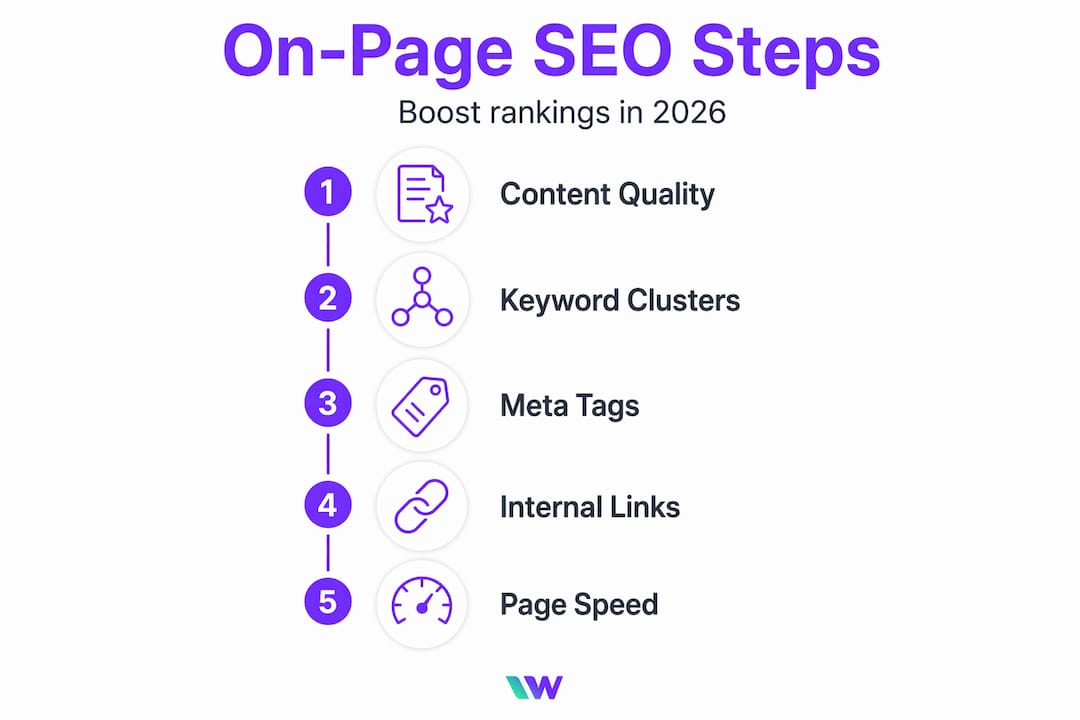
The core elements include:
- Content quality and relevance: Does your page genuinely answer the searcher’s question with depth and accuracy?
- Keyword usage: Are your target terms used naturally, in the right places, without overuse?
- Heading structure: Do your H1, H2, and H3 tags create a logical hierarchy that helps both readers and crawlers?
- Meta tags: Title tags and meta descriptions summarise your page for search engines and users scanning results.
- Technical basics: Page speed, mobile responsiveness, and clean HTML all affect how Google indexes and ranks your content.
- Internal linking: Connecting your pages helps distribute authority and makes it easier for search engines to understand your site’s structure.
Pro Tip: Write your title tag for the person scanning search results, not just for Google. The title tag influences roughly 15% of ranking signals, but its real job is to earn the click.
Each of these factors works together. A page with great content but a slow load time, or strong keywords but a confusing heading structure, will underperform. On-page SEO is about the whole picture.
How on-page SEO has changed in 2026
The single biggest shift in on-page SEO over the past two years is the rise of AI-driven search. Google AI Overviews, ChatGPT search, and other AI-powered discovery tools now pull answers directly from web pages. If your content isn’t structured clearly, those tools may simply overlook it.

On-page SEO has shifted from keyword reliance towards signals, intent, and data quality. Search engines no longer just scan for the presence of a keyword. They analyse the full semantic context of a page to judge whether it genuinely satisfies a search query. For a small business, this means thinking about topics, not just terms.
Here’s how to adapt your approach for 2026:
- Write for intent, not exact match. Ask yourself what the searcher actually wants to achieve, then build your content around that outcome. A local plumber’s page shouldn’t just target “plumber Lewes”. It should address common questions, explain the process, and demonstrate expertise.
- Implement structured data. JSON-LD schema markup tells search engines what your content means, not just what it says. Structured data implementation can increase rich snippet eligibility by up to 300% and improve click-through rates by 30 to 45%. For a product page, a review page, or a local business listing, that’s significant.
- Optimise for AI-driven search platforms. Structure your content so AI tools can extract clear answers. Use short, direct paragraphs. Label sections clearly with descriptive headings. Put your main answer near the top of the page.
- Use content clusters. SEO is shifting from isolated keyword targeting towards content clusters and intent-driven strategies. Group related pages around a central topic to signal authority across an entire subject area, not just a single page.
The good news for small businesses is that none of this requires a large team. It requires consistency, clarity, and a willingness to think about what your audience genuinely needs. Read more about how these 2026 SEO trends affect businesses in the South East and beyond.
Practical on-page SEO techniques
Understanding the theory is one thing. Actually improving your pages is another. Here are the techniques that make the biggest difference, explained plainly.
Keyword clustering and topic authority
Rather than targeting a single keyword per page, group related terms together. A page about “on-page SEO checklist” might naturally also cover “on-page SEO strategies”, “best practices for on-page SEO”, and “what factors affect on-page SEO.” This approach builds topic authority through clustering and is far more effective than one page per keyword. Google tokenises content for indexing, meaning semantic relevance and comprehensive coverage matter more than exact-match repetition.
Semantic HTML and content placement
Where your content lives on the page affects how Google values it. Google prioritises main content in the central body of a page over content in headers, footers, or sidebars. Using semantic HTML elements such as ”
,
, and helps search engines identify which parts of your page are central versus peripheral. This is especially relevant if your site was built on a template that wraps content in genericTitle tags and meta descriptions
Here’s the comparison that often surprises people:
| Element | Direct ranking impact | Impact on CTR |
|---|---|---|
| Title tag | High (approx. 15% of algorithm) | High |
| Meta description | Low to none | High |
| Schema markup | Indirect | High |
Meta descriptions are not guaranteed to appear as your snippet in search results. Google may rewrite them using on-page content it judges more relevant. This means your page content must support your key messages, not just your meta tags.
Internal linking
Link related pages together using descriptive anchor text. A page about on-page SEO techniques should link to your page on keyword research, technical SEO, or content strategy where relevant. This distributes authority across your site and helps crawlers understand the relationship between pages. Read about keyword strategy approaches for more on how to connect your content meaningfully.
Image optimisation
Every image on your page is an opportunity. Use descriptive, keyword-relevant file names. Write alt text that accurately describes the image for accessibility and for search engines. Keep file sizes small to protect page speed.
Pro Tip: If two pages on your site are targeting the same keyword, Google will struggle to decide which to rank. This is keyword cannibalisation. Audit your content regularly and consolidate overlapping pages to protect your search engine rankings before they suffer.
Common on-page SEO mistakes to avoid
Even well-intentioned SEO efforts can go wrong. These are the mistakes that quietly drag rankings down, often without any obvious warning signs.
- Keyword stuffing. Repeating a keyword unnaturally throughout a page doesn’t help; it hurts. Keyword stuffing is penalised by search engines and erodes user trust. Write naturally for people first.
- Soft 404 errors. These occur when a page returns a 200 OK status but displays thin, empty, or error content. Soft 404s lead to crawl waste and cause Google to de-prioritise your pages. Check your site regularly using Google Search Console.
- Ignoring mobile optimisation. Google uses mobile-first indexing. If your pages are hard to use on a phone, your rankings will reflect that regardless of how good the desktop version looks.
- Duplicate content. Having the same or very similar content across multiple URLs confuses search engines and splits any ranking potential. Use canonical tags where appropriate and avoid creating near-identical pages.
- Overrelying on meta descriptions. Writing a polished meta description and leaving the page content thin is a common mistake. Meta descriptions cannot guarantee your snippet text, and without strong on-page content, any click you earn will result in a fast bounce.
- Burying your main content. If your key information is below a wall of images, promotional banners, or navigation elements, Google’s positional analysis may not give it the weight it deserves. Lead with substance.
My take: why on-page SEO matters more than ever for small businesses
I’ve worked with small businesses and marketers long enough to notice a pattern. The ones who struggle with search visibility often aren’t doing anything dramatically wrong. They’re just doing things slightly out of date. They’re still thinking about keywords as a checklist item rather than as a reflection of what their audience actually wants to find.
In my experience, the businesses that gain the most ground aren’t necessarily the ones spending the most money. They’re the ones who’ve taken the time to understand on-page SEO properly and applied it consistently. A well-structured page with clear headings, honest and thorough content, and a properly tagged title will outperform a flashier competitor every single time, given enough patience.
What I’d say to any small business owner reading this: don’t chase AI gimmicks or shortcuts. The fundamentals of on-page SEO have not changed as much as people claim. What’s changed is the context around them. Content that genuinely helps your audience, structured clearly and technically sound, is what works both for traditional search and for AI-powered discovery. Start there and build outward.
— James
How MB Web can help with your on-page SEO
At MB Web, we’ve spent 50 years working alongside local and national brands, and we know that on-page SEO doesn’t happen by accident. It’s built into the way a website is designed, developed, and maintained from day one.
Whether you need a full SEO audit and optimisation service or a new website built with performance and search visibility at its core, we’d love to help. Our web design service is crafted with SEO in mind, from semantic HTML structure to mobile-first responsiveness. We’re based in Lewes, East Sussex, and we work with businesses across the region and beyond. If you’d like an honest conversation about what your site needs, get in touch. Let’s talk.
FAQ
What is on-page SEO in simple terms?
On-page SEO is the process of optimising the content and structure of your website’s individual pages so search engines can understand them and rank them for relevant searches. It covers everything from headings and keywords to page speed and metadata.
How does on-page SEO differ from off-page SEO?
On-page SEO refers to factors you control directly on your website, such as content, title tags, and internal links. Off-page SEO covers external signals like backlinks and brand mentions from other websites.
What factors affect on-page SEO rankings?
Key factors include content quality and relevance, heading structure, title tags, page speed, mobile responsiveness, internal linking, image alt text, and structured data. Google also gives more weight to content positioned in the main body of a page rather than in sidebars or footers.
Do meta descriptions directly affect Google rankings?
No. Meta descriptions do not directly influence rankings, but they do affect click-through rate. Google may also rewrite your meta description using on-page content if it judges another passage more relevant to the query.
How often should I update my on-page SEO?
Review your key pages at least every six months. Search intent shifts, algorithms update, and your own content can become outdated. Regular audits using tools like Google Search Console help you spot issues before they affect performance.