

SEO for estate agents: attract more clients in Sussex
TL;DR:
- Having a website alone does not guarantee increased buyer or seller inquiries without effective SEO.
- Estate agents need to implement both on-page and off-page SEO strategies, including local content, Google profiles, and quality links, to improve visibility.
- Consistent, ongoing SEO efforts yield the best long-term results, as regular updates and technical optimizations build authority and attract relevant traffic.
Having a website is a good start, but it won’t automatically bring buyers and sellers to your door. Many estate agents across Sussex and the South East invest in a well-designed site, then wonder why the phone isn’t ringing. The truth is, without Search Engine Optimisation (SEO), even the most attractive website can sit quietly on page three of Google, unseen by the very people you want to reach. This guide explains what SEO really means for estate agents, how it works in practice, and the steps you can take right now to improve your visibility and win more instructions.
Table of Contents
- What SEO means for estate agents
- Core elements of effective estate agent SEO
- Practical strategies estate agents can use today
- SEO pitfalls to avoid in the estate agency sector
- Why consistency beats quick fixes in estate agent SEO
- How to get expert help with your estate agency SEO
- Frequently asked questions
Key Takeaways
| Point | Details |
|---|---|
| SEO drives visibility | Search engine optimisation makes it easier for clients to find your agency online. |
| Consistency matters most | Regular, small SEO improvements work better than chasing quick wins. |
| Mobile optimisation is vital | Most property searches are made on mobile devices, so your website must perform well on them. |
| Avoid common pitfalls | Outdated content and poor site structure can undermine even the best SEO plan. |
What SEO means for estate agents
With the importance of being found online established, let’s break down what SEO actually involves for estate agents.
SEO stands for Search Engine Optimisation. In plain terms, it’s the process of making your website more visible to people using Google to search for properties or estate agents in your area. When someone types “estate agent in Lewes” or “houses for sale in Brighton,” SEO determines whether your site appears at the top of the results, or gets buried several pages down where almost no one looks.
There are two main types of SEO to understand. On-page SEO covers everything you do directly on your website: the words you use, the headings, the page titles, and the content you publish. Off-page SEO refers to activity that happens away from your site, such as other reputable websites linking back to you, your Google Business Profile, and your presence on local directories. Both matter, and they work together.
“A well-optimised website helps estate agents increase online visibility and attract a steady stream of clients who are actively searching for property services.”
Here’s what good SEO delivers for estate agents specifically:
- More relevant visitors arriving at your website each month
- Higher volumes of valuation enquiries from local homeowners
- Stronger visibility in searches for specific towns, villages, and postcodes across Sussex
- A credible, professional online presence that builds trust before you’ve even spoken to a prospect
One of the most persistent myths we hear from estate agents is “I just need a nice website.” A beautiful website with no SEO is a bit like a brilliant high street office with no sign above the door. People simply won’t find it.
Pro Tip: Update your property listings regularly. Search engines love fresh content, and regularly refreshed listings signal to Google that your site is active and relevant, which can give you a quiet but meaningful ranking boost.
Exploring digital marketing for estate agents as a whole gives you an even stronger foundation, because SEO works best when it sits alongside social media, content, and email activity.
Core elements of effective estate agent SEO
Once you understand what SEO is, it’s time to dig into the essentials that make estate agent sites perform well in search.
Getting SEO right is not about one big move. It’s about consistently attending to several interconnected elements. Here are the key building blocks:
- Keyword research: Identify the exact phrases your target clients type into Google. Think “sell my house in Hove,” “letting agents Eastbourne,” or “buy a flat in Lewes.” These phrases should appear naturally throughout your content.
- Location-specific content: Add town, village, and postcode references throughout your pages. A page titled “Properties for sale in Seaford” will consistently outperform a vague generic page.
- Google Business Profile: Claim and fully complete your listing. Include opening hours, photos, services, and gather genuine reviews from past clients.
- Property listing schema: This is a type of structured data (code added to your site) that helps Google understand your listings and display rich results in search. Your developer can add this for you.
- Fast, mobile-friendly website: If your site loads slowly or looks broken on a smartphone, Google penalises your ranking. Responsive websites that adapt perfectly to any screen size are now a fundamental SEO requirement, not a luxury.
- Quality inbound links: Earn links from local business directories, property portals, local press, and community websites to build your site’s authority.
Pro Tip: Your Google Business Profile is often the first thing a potential client sees. A complete, regularly updated profile with genuine five-star reviews can be more powerful than almost any other single SEO action you take.
The importance of mobile performance cannot be overstated. Mobile-first web design ensures your site is built for smartphone users first, which is exactly how Google ranks sites today. Over half of all property searches now happen on mobile devices, so if your site isn’t fast and responsive, you’re handing enquiries to your competitors.

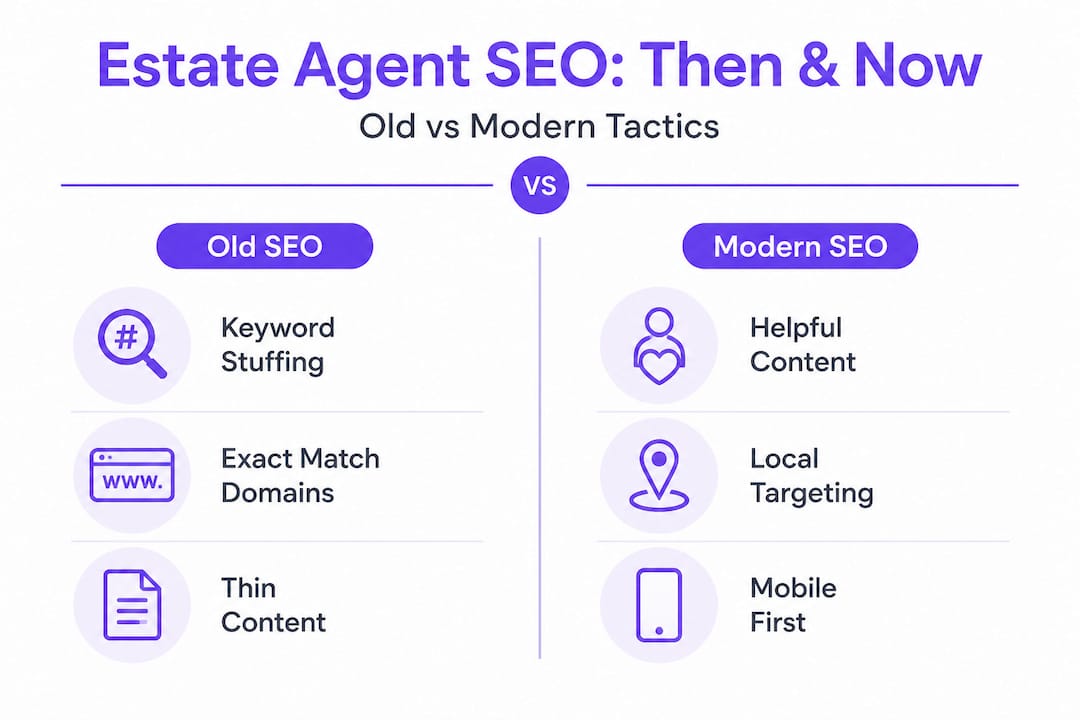
Here’s a simple comparison to show how SEO thinking has evolved:
| Old SEO tactics | Modern SEO best practice |
|---|---|
| Stuffing keywords into every paragraph | Using keywords naturally within helpful content |
| Generic “properties for sale” pages | Specific location pages for each area you serve |
| Links from any website | Links from reputable, relevant local sources |
| Desktop-only design | Fully responsive, mobile-first design |
| Set-and-forget approach | Regular content updates and technical checks |
| Ignoring Google Business Profile | Actively managing and updating your profile |
The shift from old to new SEO is really a shift from gaming the system to genuinely serving your audience. Google has become very good at telling the difference.
Practical strategies estate agents can use today
Understanding key elements leads naturally into what you can actually do, so let’s explore practical strategies you can apply from today.
You don’t need to overhaul everything at once. Start with quick wins that create real momentum. A website that is structured with user experience in mind performs better in search because visitors stay longer, browse more pages, and are more likely to get in touch. These are signals Google reads and rewards.
Here are content ideas that work particularly well for Sussex estate agents:
- Local area guides: Write detailed pages about the towns and villages you cover. Cover schools, transport links, average property prices, and lifestyle. These pages attract buyers who are still researching locations.
- Market update articles: A monthly or quarterly post on the local property market positions you as the expert and keeps your site fresh.
- Buyer and seller FAQs: Answer the questions you’re asked every day. “How long does conveyancing take in Sussex?” or “What’s the best time to sell in Brighton?” These articles attract targeted, ready-to-act searchers.
- Case studies and testimonials: Real stories from real clients build trust and add unique content that no competitor can copy.
- Video walkthroughs: Embedding property videos increases time spent on your site, which is another positive SEO signal.
Here’s a practical overview of example keywords and search intent to help you prioritise:
| Keyword example | Search intent | Priority level |
|---|---|---|
| “Estate agents in Lewes” | Finding a local agent | High |
| “Houses for sale in Brighton” | Actively searching for property | High |
| “How to sell my house in Sussex” | Research and intent to instruct | Medium |
| “Average house prices Eastbourne 2026” | Market research | Medium |
| “Buy to let mortgage advice Sussex” | Financial research | Low to medium |
Beyond content, technical factors matter enormously. Site speed affects both your ranking and your bounce rate (the number of people who leave immediately). Compressing images, using professional web hosting designed for performance, and minimising unnecessary code all make a measurable difference. Applying proven SEO marketing techniques alongside a well-structured site is one of the most effective combinations available to estate agents today.
If your site needs a rebuild to support these improvements, a purpose-built estate agent website design gives you the right foundation from the start.
SEO pitfalls to avoid in the estate agency sector
With strategies in hand, it’s just as vital to know what NOT to do. Many estate agents fall into these common traps.
Avoiding mistakes is as important as applying best practice. Several common SEO errors can hold estate agents back from ranking higher, often without them even realising it.
Here are the most damaging pitfalls:
- Slow or unreliable web hosting: If your site takes more than three seconds to load, a significant proportion of visitors leave before seeing a single property. Cheap hosting is rarely worth the saving.
- Keyword stuffing: Repeating the same phrase over and over in an unnatural way no longer fools Google. It actually damages your ranking and makes your content unpleasant to read.
- Duplicate content: Copying property descriptions directly from Rightmove or Zoopla onto your site creates duplicate content, which Google penalises. Write original descriptions wherever possible.
- Ignoring schema markup: Without structured data, Google has to guess what your property listings are about. Adding property schema helps your listings appear with rich results, including price, location, and availability, directly in the search results page.
- Thin or outdated content: Pages with very little text, or content that hasn’t been updated in years, are ranked poorly. Stale pages suggest to Google that your site isn’t being actively maintained.
- Neglecting voice search and AI-driven search: More people are using voice assistants and AI tools to find local services. Phrases like “find an estate agent near me” or “who sells houses in Seaford” require conversational, question-and-answer content on your site.
“One of the most damaging and overlooked SEO errors is simply leaving your website untouched for months on end. Google rewards activity and freshness, not set-and-forget.”
If your current site is holding you back, exploring the benefits of a website redesign is worth doing sooner rather than later. Understanding the full website development process also helps you make informed decisions and avoid expensive rework.
The good news is that every one of these mistakes is fixable. With the right knowledge and a bit of consistent effort, you can sidestep these traps entirely and build a site that works hard for your business every day.
Why consistency beats quick fixes in estate agent SEO
Here’s our honest take on this, and it’s something we feel strongly about having worked with estate agents across Sussex for many years. The agencies that win at SEO are almost never the ones who paid for a quick fix or published a flurry of content and then went quiet. They’re the ones who show up, week after week, making small improvements.
A consistent approach to SEO might mean publishing one well-researched local area guide each month. It might mean checking your Google Business Profile every fortnight, responding to reviews, and adding new photos of your team. It might mean setting aside an hour each quarter to review your page speeds and fix any broken links. None of these tasks are dramatic. But they compound over time in a way that quick fixes simply cannot replicate.
We’ve seen estate agents in East Sussex go from invisible on Google to appearing consistently on page one for multiple local search terms, not because they threw money at a one-off campaign, but because they committed to steady, purposeful improvement. That kind of result takes three to six months to build, and then it holds. It isn’t fragile in the way that paid ads can be. When you stop paying for ads, the traffic stops. When you stop paying attention to SEO, the results fade slowly, giving you time to course-correct.
The practical takeaway is this: build SEO habits, not just SEO projects. Explore the full range of resources available through our estate agent content marketing blog for ideas you can act on regularly.
Pro Tip: Create a simple monthly SEO checklist: one new content piece, one technical review, one profile update. That’s it. Three small actions, repeated consistently, will outperform a single large effort in the long run.
How to get expert help with your estate agency SEO
If you’re ready to take the next step beyond DIY SEO, expert support can make all the difference. Knowing what to do and having the time and resource to do it consistently are two very different things. That’s where we come in.
At MB Web, we’ve spent 50 years working with local and national brands, and we understand the Sussex property market intimately. We offer tailored support across web design for estate agents, website development, and dedicated SEO services built specifically around the goals of estate agents in this region. Whether you need a full site rebuild, a targeted SEO audit, or ongoing monthly support, we’d love to have a conversation. Let’s talk about where your business is now and where you’d like it to be. Get in touch today.
Frequently asked questions
How quickly can SEO results be seen for estate agents?
SEO improvements may show some early results within a few weeks, but sustainable ranking and traffic growth typically takes three to six months of consistent effort.
Does Google My Business still matter for estate agents in 2026?
Yes, a complete and verified Google Business Profile remains crucial for attracting local buyers and sellers in your area.
Which SEO mistake is most common among estate agents?
Failing to update property listings and website content regularly is one of the most frequent and damaging mistakes, as common SEO errors like stale content signal neglect to Google.
Is professional web hosting important for SEO?
Yes, reliable web hosting directly affects your site speed, uptime, and overall search ranking, all of which Google measures and acts upon.
What content should estate agents focus on for better SEO?
Focus on regularly updated property listings, local market insights, and practical answers to the questions buyers and sellers ask most often, as these attract the most relevant search traffic.